
Quick answer
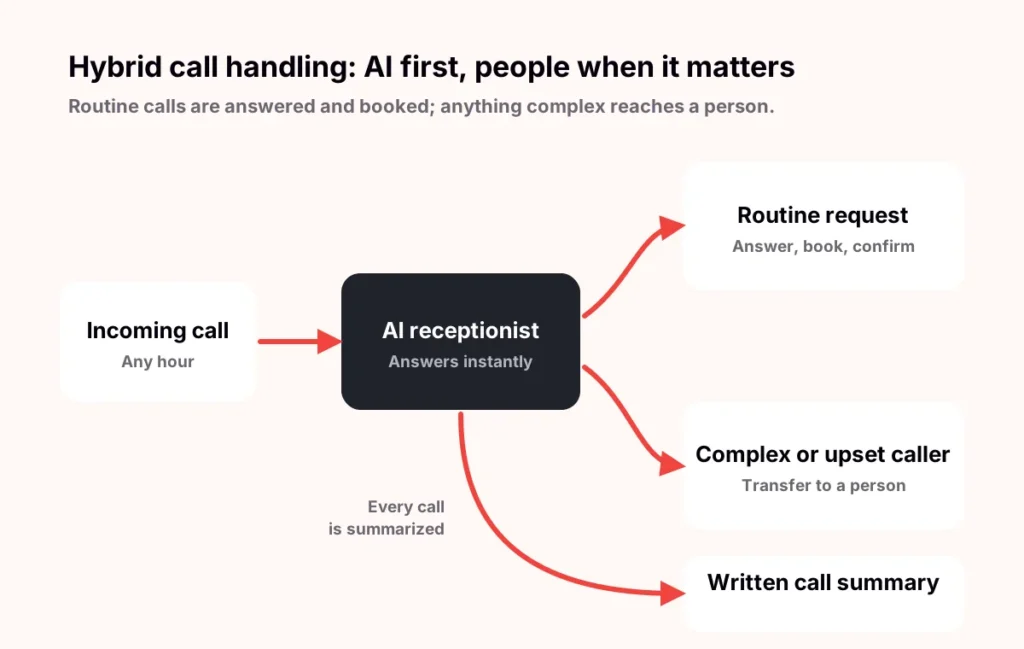
An AI receptionist suits businesses whose calls are mostly routine, such as booking, hours and service questions, because it answers instantly at any hour and can book straight into a calendar. A live answering service suits calls that need empathy or judgment. Many small businesses get the best result by using AI first, with a clear handoff to a person.
Key takeaways
- AI receptionists answer every call immediately and can book appointments; most answering services take messages.
- People handle distressed, complex or sensitive callers better, so build in a transfer path.
- Tell callers they are speaking with an automated assistant, and check your state’s call-recording rules.
- Test with after-hours calls first, review two weeks of summaries, then decide whether to expand.
What is an AI receptionist?
An AI receptionist is a voice assistant that answers your business phone line, follows a script you approve, answers common questions, collects caller details, books appointments in a connected calendar and transfers the call to a person when needed. After each call it sends you a written summary.

What is a traditional answering service?
A live answering service is a team of trained operators who answer calls on your behalf, usually from a shared call center. They typically take messages, follow simple instructions and forward urgent calls, and they are billed per minute or per call.
AI receptionist vs. answering service: side by side
| Compared | AI receptionist | Live answering service |
|---|---|---|
| Availability | Every call, any hour, no hold queue | Usually 24/7, hold times vary with call volume |
| Booking | Books directly into a connected calendar | Usually takes a message for you to call back |
| Consistency | Follows the same approved script every time | Varies by operator |
| Complex or emotional calls | Should transfer to a person | Handled by a person |
| Call records | Written summary and transcript after each call | Message notes |
| Pricing model | Platform fee plus usage | Per minute or per call |
When is an AI receptionist the better fit?
- Most calls are about hours, location, pricing ranges or booking.
- You miss calls while on jobs, with patients or after closing.
- You want appointments booked during the call rather than a callback list.
- You want a written record of every call.
When is a live answering service the better fit?
- Callers are often upset, anxious or in a crisis.
- Each call needs judgment that is hard to write into a script.
- Your callers strongly prefer to speak with a person.
Can a small business use both?
Yes, and it is often the most practical setup. The AI receptionist answers first, handles routine requests and books appointments, and transfers anything urgent, sensitive or unclear to your team or to a live service. You keep fast answers without losing the human touch where it matters.
What should you check before choosing?
- Disclosure. The assistant should say it is automated. In February 2024 the FCC ruled that AI-generated voices in outbound robocalls count as “artificial” voices under the Telephone Consumer Protection Act. That ruling covers outbound calls, but it shows how seriously regulators treat AI voices, and being upfront protects trust.
- Call recording consent. Several states require every party to consent before a call is recorded. Make sure the greeting covers this if calls are recorded.
- Transfer rules. Decide exactly which situations go to a person, and test them.
- Calendar and CRM connections. Confirm the platform supports the tools you use before you sign up.
- Health information. Dental and medical practices handling protected health information need vendors that will sign a HIPAA business associate agreement.
How to test an AI receptionist in two weeks
- Route after-hours calls only to the AI receptionist.
- Read every call summary and listen to a sample of recordings.
- Fix the script wherever callers got stuck or repeated themselves.
- Count the appointments booked that would otherwise have gone to voicemail.
- Decide whether to extend it to daytime overflow calls.
You can hear a sample after-hours call, with a booked appointment and written summary, on the AI voice receptionist page.
Frequently asked questions
Is an AI receptionist cheaper than an answering service?
Often, for businesses with many short routine calls, because pricing is usually a platform fee plus usage rather than per-minute operator time. For a handful of long, complex calls a month, a live service can cost less.
Will callers know they are talking to AI?
They should. The assistant should introduce itself as an automated assistant, which keeps trust intact and avoids regulatory problems.
Can an AI receptionist book appointments?
Yes, when it is connected to a supported calendar. It offers open slots during the call and sends a confirmation.
What happens when the AI cannot help a caller?
It should transfer the call to a person or take a detailed message, based on rules you set. Test those rules before going live.
Sources
- Cooley: FCC rules AI-generated robocalls illegal under the TCPA (February 2024)
- U.S. Department of Health and Human Services: Business associates under HIPAA
Related service
AI Voice Receptionist
Calls are answered on the second ring, routine questions are handled and you get a short written summary of each conversation.