
Quick answer
An AI consultant helps a small business decide where artificial intelligence is worth using, chooses the right tools and sets them up so they work in daily operations. For most small businesses that means automating follow-ups, answering customers faster and organizing information, not building custom software.
Key takeaways
- An AI consultant finds the few tasks where AI saves real time, then implements and tests the fix.
- Most small-business projects use existing tools such as CRMs, chat assistants and automation platforms.
- A good engagement starts with a written assessment and a short list of priorities, not a software purchase.
- Ask any consultant how they keep a person in the loop and who owns the accounts when the project ends.
What is an AI consultant?
An AI consultant is an advisor who studies how a business operates and recommends where AI and automation should, and should not, be used. Unlike a software vendor, a consultant is not selling one product. Unlike a developer, the goal is rarely to write new code. The job is to match proven tools to real problems and make them reliable enough that your team keeps using them.
What does an AI consultant actually do?
The work usually falls into four stages. Each one should leave you with something useful, even if you stop there.
1. Finds the problems worth solving
Most businesses have dozens of tasks that could be automated and only a handful that are worth it. A consultant looks at where time and leads are lost, such as missed calls, slow replies to quote requests or the same data typed into three systems, and ranks each opportunity by time saved, cost and risk.
2. Chooses the right tools
There are thousands of AI products. An independent consultant narrows the field to the two or three that fit your budget, the software you already pay for and your team’s comfort level. Often the best answer is a feature you already own but have never switched on.
3. Implements and tests the solution
A plan only helps if it gets built. Implementation covers setup, connecting your tools, testing with real examples and deciding exactly where a person reviews the output before a customer sees it.
4. Trains your team and improves the system
After launch, a consultant shows your staff how the system works, watches for errors in the first weeks and adjusts what misfires. This is the stage most often skipped, and the main reason AI tools get abandoned.
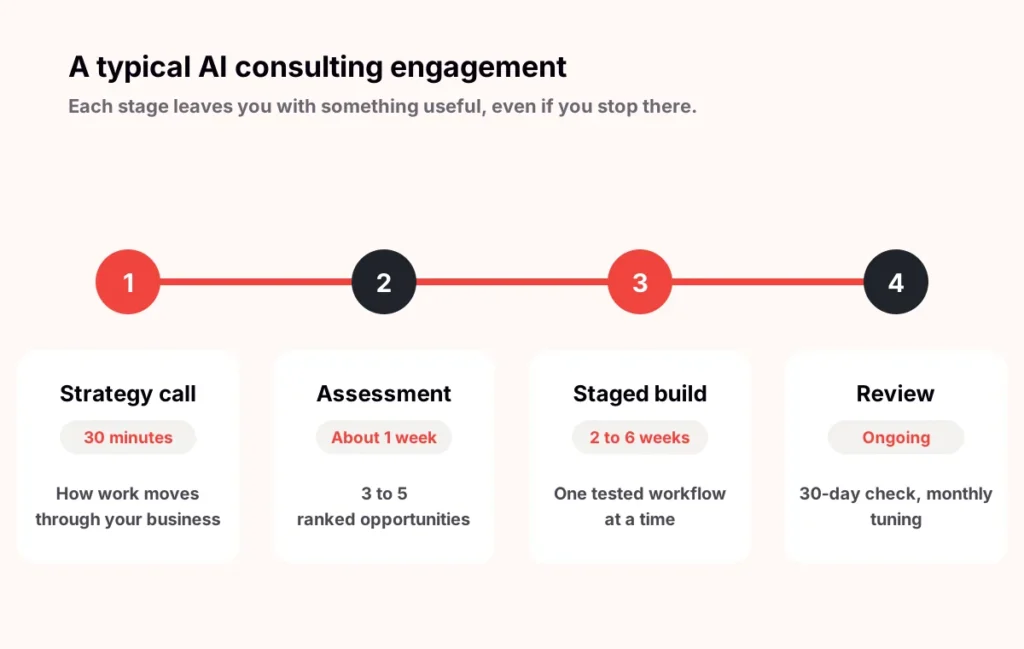
What does an AI consulting engagement look like?
Timelines vary with scope, but a focused small-business engagement often follows this pattern:
- Strategy call (30 minutes). You describe how leads, customers and admin move through the business.
- Assessment and roadmap (about one week). You receive three to five prioritized opportunities with effort and cost ranges.
- Staged build (two to six weeks). One workflow at a time, tested before the next begins.
- Review and improvement. A 30-day check, then optional monthly sessions to tune and add the next improvement.
AI consultant vs. AI agency vs. software developer
| Compared | AI consultant | AI agency | Software developer |
|---|---|---|---|
| Main job | Choose and implement the right solution | Deliver a package of services | Build custom software |
| Who you work with | Usually the consultant directly | An account manager and a team | One or more engineers |
| Typical tools | Existing platforms and integrations | Often the agency’s preferred stack | Custom code |
| Best for | Unclear where to start, or tools that did not stick | A defined, larger scope | A unique product or process |
| Ongoing cost | Optional monthly support | Usually a retainer | Maintenance and hosting |
How do you know if your business needs an AI consultant?
You probably do not need one for a single, well-defined task, such as adding a chat assistant to your website. A consultant earns their fee when:
- You know AI could help but are unsure where to start.
- You have bought tools that your team stopped using.
- Leads or customer questions regularly slip through the cracks.
- Your information lives in several systems that do not talk to each other.
Questions to ask before you hire an AI consultant
- Will I work with you directly, or be handed to someone else?
- How do you decide which tools to recommend, and do you earn commissions on them?
- Where will a person review AI output before it reaches a customer?
- Whose name are the accounts in, and what happens if we stop working together?
- What will I have in writing after the first stage?
If you want a starting point before talking to anyone, the free AI opportunity assessment gives a preliminary recommendation from six questions.
Frequently asked questions
What does an AI consultant do for a small business?
An AI consultant identifies tasks where AI or automation would save time or improve customer response, recommends suitable tools, and helps implement, test and maintain them so they hold up in daily use.
How much does AI consulting cost?
It depends on scope. An assessment is usually a fixed fee, implementation is priced per project, and ongoing support is a monthly fee. Ask for a written price before any work starts.
How long does it take to see results?
A single workflow, such as automatic replies to new inquiries, is often live within two to four weeks. Larger programs are delivered in stages so something useful works early.
Do I need technical staff to work with an AI consultant?
No. A good consultant handles setup, explains decisions in plain language and trains whoever will use the system day to day.
Related service
AI Consulting & Implementation
I help you work out where AI is worth using, in what order, with which tools, and then I build it with you.